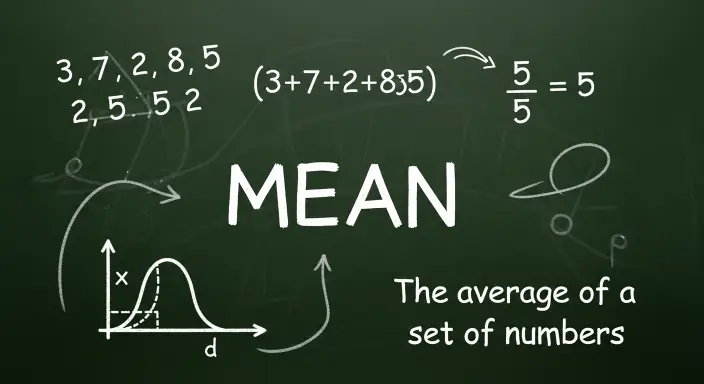
Have you ever wondered what people mean when they talk about the “mean” in math?
Chances are, you’ve heard it called the “average” in school, sports, or even when discussing money.
While the term may sound simple, understanding what the mean really is and how it works can make a big difference in solving math problems correctly.
In essence, the mean gives us a way to find the central value of a set of numbers.
It tells us what a typical number looks like within a group, helping us make sense of data, compare results, and even make decisions in daily life.
If you’re calculating your grades, analyzing sports scores, or managing your expenses, knowing how to find the mean can be incredibly useful.
In this article, we’ll break down exactly what mean means in math, show you how to calculate it, and explain how it compares to median and mode.
Definition of Mean
In mathematics, the term “mean” is commonly used to describe what most people call the average. Simply put, the mean is a way to find the central value of a set of numbers.
It tells us what a typical number in a group looks like and is useful for comparing data, understanding trends, and making decisions.
The most common type is the arithmetic mean, which is calculated by adding all the numbers together and then dividing the total by how many numbers there are.
For example, consider the numbers 2, 4, 6, and 8. First, we add them together: 2 + 4 + 6 + 8 = 20. Then, we divide by the total number of numbers, which is 4. So, 20 ÷ 4 = 5. Here, 5 is the mean of these numbers.
The mean is not only a math concept for classrooms; it appears in everyday life. Your average test score, the average daily temperature, or even the average amount you spend in a week all use the concept of mean.
By finding the mean, you get a simple number that represents the general value of a group, which can help simplify complex data.
It’s important to remember that the mean is different from other measures like median or mode, which we will explore later.
While the mean gives the overall average, it can sometimes be influenced by extremely high or low numbers, called outliers.
Step-by-Step Guide to Calculating Mean
Calculating the mean is simple once you understand the steps. Let’s break it down so anyone can follow along.
Step 1: Add all the numbers together
Start by writing down all the numbers in your set and adding them. For example, if your numbers are 3, 7, 5, and 10, add them:
3 + 7 + 5 + 10 = 25
Step 2: Count the numbers
Next, count how many numbers are in the set. In our example, there are 4 numbers.
Step 3: Divide the total by the count
Now, divide the sum by the number of values:
25 ÷ 4 = 6.25
So, the mean is 6.25
Example 2 – Larger numbers
Imagine your test scores are 80, 90, 70, and 100. Add them together: 80 + 90 + 70 + 100 = 340. Divide by 4 (the total number of tests): 340 ÷ 4 = 85. The mean score is 85.
Example 3 – Decimals
Numbers: 2.5, 3.5, 4.0, 5.0
Sum: 2.5 + 3.5 + 4.0 + 5.0 = 15.0
Divide by 4 → 15 ÷ 4 = 3.75
The mean is 3.75
Using these steps, you can calculate the mean of any set of numbers, whether they are whole numbers, decimals, or even negative numbers. The key is always sum first, then divide by the total count.
Types of Mean
While most people are familiar with the arithmetic mean, there are several types of mean used in mathematics and statistics, each with its own purpose. Understanding the differences helps in applying the right one to the right situation.
1. Arithmetic Mean
This is the standard mean we calculate by adding all numbers and dividing by the total count. For example, the mean of 4, 6, and 8 is (4 + 6 + 8) ÷ 3 = 6. It is the most commonly used type in everyday situations, like averaging grades or scores.
2. Weighted Mean
Sometimes, not all numbers contribute equally. The weighted mean gives more importance to certain values. For example, if your homework counts for 40% and your exam counts for 60%, the weighted mean is calculated as:
(Score₁ × Weight₁ + Score₂ × Weight₂) ÷ Total Weight
3. Geometric Mean
The geometric mean multiplies all numbers together and then takes the nth root (where n is the total number of numbers). It is useful for data that grows exponentially, like interest rates or population growth. For example, the geometric mean of 2 and 8 is √(2×8) = √16 = 4.
4. Harmonic Mean
The harmonic mean is calculated as the reciprocal of the average of reciprocals of the numbers. It is useful in situations like calculating average speed over a distance. For example, if you travel 60 km at 30 km/h and 60 km at 60 km/h, the harmonic mean gives the correct average speed.
By understanding these types of mean, you can choose the right one for your problem, making your calculations more accurate and meaningful.
Mean vs Median vs Mode
In statistics, mean, median, and mode are three different ways to describe the “average” of a set of numbers, but each measures it in a slightly different way. Understanding their differences is important because they can give different insights about the same data.
1. Mean
As we discussed, the mean is the sum of all numbers divided by the total count. It is sensitive to every value in the set. For example, in the numbers 2, 4, 6, 100, the mean is (2 + 4 + 6 + 100) ÷ 4 = 28. Here, the extremely high number 100 (an outlier) raises the mean, making it less representative of the typical value.
2. Median
The median is the middle number when the data is arranged in order. Using the same numbers 2, 4, 6, 100, we first order them: 2, 4, 6, 100. Since there is an even count, the median is the average of the two middle numbers: (4 + 6) ÷ 2 = 5. The median is less affected by outliers, so it represents the central value more reliably when extreme numbers exist.
3. Mode
The mode is the number that occurs most frequently. For example, in 2, 4, 4, 6, 100, the mode is 4 because it appears twice. Mode is useful for identifying the most common value, especially in categorical or repeated data.
Summary:
- Mean: overall average, influenced by all numbers
- Median: middle value, resistant to outliers
- Mode: most frequent value
By comparing mean, median, and mode, you can understand data better and choose the best measure for your situation.
Real-Life Examples of Mean
The concept of mean is not just for classrooms it appears in everyday life. Understanding how to calculate it can help you make sense of numbers in practical situations. Here are some common examples:
1. Grades in School
Imagine you have four test scores: 85, 90, 78, and 92. To find the mean:
85 + 90 + 78 + 92 = 345
345 ÷ 4 = 86.25
Your mean score is 86.25, which represents your overall performance.
2. Average Daily Temperature
Suppose the temperatures for a week are 70°F, 72°F, 68°F, 71°F, 69°F, 73°F, and 70°F. Adding them together: 70 + 72 + 68 + 71 + 69 + 73 + 70 = 493
493 ÷ 7 = 70.43
The mean temperature is 70.43°F, giving you an idea of the typical weather that week.
3. Sports Scores
A basketball player scores 12, 15, 20, 10, and 18 points in five games. The mean score is:
12 + 15 + 20 + 10 + 18 = 75
75 ÷ 5 = 15
On average, the player scores 15 points per game.
4. Household Expenses
If you spent $200, $150, $300, $250, and $100 in a week, the mean spending is:
200 + 150 + 300 + 250 + 100 = 1000
1000 ÷ 5 = 200
You spend an average of $200 per week, which can help you plan a budget.
These examples show that mean is a simple yet powerful tool to summarize data and make informed decisions, whether it’s for school, work, or daily life.
Common Mistakes When Calculating Mean
Even though calculating the mean is straightforward, many people make common mistakes that can lead to incorrect results. Being aware of these pitfalls can help you avoid errors.
1. Forgetting to Include All Numbers
One of the simplest mistakes is leaving out a number when adding the set. For example, if your numbers are 5, 10, 15, and 20, forgetting the 20 would give a mean of (5 + 10 + 15) ÷ 3 = 10, instead of the correct (5 + 10 + 15 + 20) ÷ 4 = 12.5. Always double-check that every number is included.
2. Confusing Mean with Median or Mode
Mean is often confused with median or mode. Remember: mean is the total sum divided by the count, median is the middle value, and mode is the most frequent number. Using the wrong method can give misleading results, especially if there are outliers in your data.
3. Ignoring Weighted Values
Sometimes not all numbers are equal. For example, in a class, homework might count 40% and the exam 60%. Using the simple arithmetic mean without considering weights will give an inaccurate result.
4. Misinterpreting Outliers
Extreme values, like very high or low numbers, can distort the mean. For instance, if most scores are around 80 but one score is 1000, the mean will be much higher than typical. Knowing when to use median instead can prevent misrepresentation.
5. Calculation Errors
Simple arithmetic mistakes, like wrong addition or division, can also lead to incorrect mean. Double-checking calculations or using a calculator helps prevent errors.
By avoiding these mistakes, you can ensure your mean calculations are accurate and meaningful.
Fun Facts About Mean
While the mean is a basic math concept, it has some interesting history and trivia that many people don’t know.
1. The Word “Mean”
The term “mean” comes from the Old French word “meien,” which means “middle” or “average.” This reflects the idea that the mean represents a central value in a set of numbers. Over time, mathematicians adopted it as the standard term for what most people now simply call the “average.”
2. Used Since Ancient Times
The concept of mean has been used for thousands of years. Ancient civilizations, including the Egyptians and Babylonians, calculated averages to distribute resources, measure land, and record data. This shows that the mean is not just a classroom tool it has practical roots in history.
3. Everyday Uses
You encounter the mean more often than you realize. From tracking your monthly expenses to checking your average speed while driving or calculating your grades, the mean helps make sense of numbers in daily life.
4. Not Always the Best Measure
While the mean is very useful, it can sometimes be misleading, especially when extreme numbers (outliers) are present. That’s why statisticians often compare it with the median or mode to get a more accurate picture of data.
5. Fascinating Fact
In some fields like finance and biology, advanced types of mean, such as geometric mean and harmonic mean, are used to describe growth rates and averages in special situations, showing how versatile this simple concept really is.
The mean is more than a number it’s a historical, practical, and mathematically powerful tool.
FAQs:
1. What is the mean in math?
The mean, often called the average, is the sum of all numbers in a set divided by the total number of numbers. It represents the central value or typical number in the data.
2. Is mean the same as average?
Yes, in most cases, mean and average are used interchangeably. However, “average” can sometimes refer to median or mode, depending on context, while mean specifically refers to the arithmetic mean.
3. How do you calculate the mean?
Add all the numbers in a set together, then divide the sum by the total count of numbers. For example, for 5, 10, and 15: (5 + 10 + 15) ÷ 3 = 10.
4. What is the difference between mean, median, and mode?
- Mean: sum of numbers ÷ count
- Median: middle value in a sorted list
- Mode: number that appears most frequently
5. When should I use the mean?
Use the mean when you want an overall average or central value, especially when the data is fairly consistent without extreme outliers.
6. What is a weighted mean?
A weighted mean gives more importance to certain numbers based on their weight. For example, grades may count differently, like homework 40% and exams 60%.
7. Can mean be misleading?
Yes. Extreme values (outliers) can skew the mean, making it higher or lower than most numbers in the set. In such cases, the median may better represent the typical value.
Conclusion:
Understanding the concept of mean in math is essential for both academic success and everyday life.
The mean, or average, provides a simple way to find the central value in a set of numbers, helping us summarize data and make sense of information.
If you are calculating your grades, tracking expenses, or analyzing sports scores, knowing how to find the mean allows you to see the bigger picture and make informed decisions.
While the arithmetic mean is the most common, it’s important to remember that there are other types of mean, such as the weighted mean, geometric mean, and harmonic mean, each designed for specific situations.
Additionally, comparing the mean with median and mode helps prevent misunderstandings, especially when data includes extreme values or outliers.
Calculating the mean is straightforward: sum all numbers, then divide by the total count.
Yet, small mistakes, such as leaving out numbers or ignoring weights, can affect accuracy.
By practicing calculations and applying the concept in real-life examples, you can gain confidence and avoid common errors.
In the end, the mean is more than just a classroom formula it is a practical and powerful tool for understanding data in everyday life.
By learning how to calculate it correctly and understanding when to use it, you can interpret numbers more effectively and make smarter choices.
So next time you encounter numbers in your day-to-day life, remember to find the mean it often tells you more than meets the eye.

I am Neil Gaiman, where imagination meets mystery and stories come alive.
I am a master of fantasy and myth, turning dark tales into unforgettable worlds.
I am proudly featured on Jokestide.com, a place where creativity and storytelling never sleep.