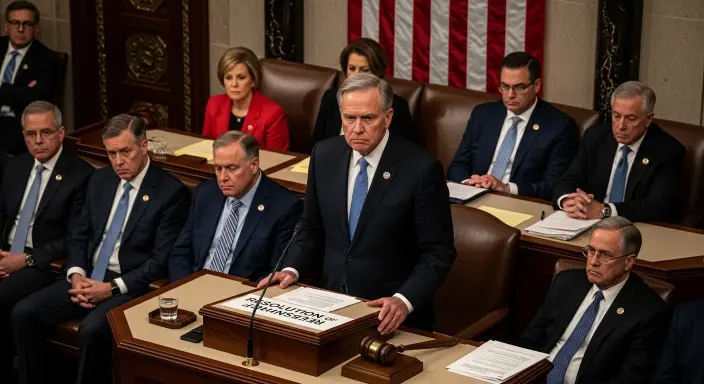
When a member of Congress breaks rules or behaves unethically, the chamber has several ways to respond.
One of the most serious but often misunderstood forms of disciplinary action is censure.
Simply put, censure is a formal statement of disapproval issued by either the House of Representatives or the Senate.
Unlike expulsion, which removes a member from office, censure does not carry legal penalties; instead, it publicly marks a member’s misconduct in the official congressional record.
While symbolic, it can have significant political consequences, affecting a lawmaker’s reputation, committee assignments, and influence in Congress.
Understanding what censure means in Congress, how it works, and why it matters is essential for anyone interested in U.S. politics.
In this article, we’ll explore the definition, process, historical examples, and lasting impact of censure, giving you a complete picture of this unique congressional tool.
Definition of Censure in Congress
In Congress, censure is a formal statement of disapproval directed at a member for misconduct, unethical behavior, or violations of congressional rules.
Unlike expulsion, which removes a member from office, censure is primarily symbolic, serving as a public reprimand rather than a legal punishment.
When a member is censured, their name and the details of the offense are recorded in the official congressional record, making it a permanent mark on their legislative history.
Censure is one of the most serious disciplinary measures available to Congress, falling between a private reprimand and full expulsion. It allows lawmakers to signal disapproval without taking the extreme step of removing a colleague from office.
The action is typically reserved for misconduct that is serious but does not warrant expulsion, such as ethical violations, conflicts of interest, or improper behavior while in office.
It is important to note that censure carries political consequences. A censured member may face public embarrassment, loss of seniority, or limitations on committee participation.
While it does not prevent them from voting or performing official duties, the stigma can influence their effectiveness and credibility in Congress.
Understanding this definition provides the foundation for exploring how censure works, its historical examples, and why it remains relevant today in maintaining ethical standards in the U.S. legislature.
How a Censure Happens in Congress
The process of censuring a member of Congress is formal and follows specific steps, ensuring that the action is fair and recorded properly.
It usually begins when a member or group of members introduces a resolution of censure.
This resolution outlines the alleged misconduct, ethical violations, or inappropriate behavior that has prompted the need for censure.
Once introduced, the resolution is typically referred to a relevant committee often the House Ethics Committee or Senate Ethics Committee for review.
The committee examines evidence, conducts hearings if necessary, and determines whether the allegations have merit.
During this stage, the accused member has the opportunity to respond, defend themselves, and provide explanations for their actions.
After the committee completes its review, the resolution proceeds to the full chamber for debate.
Members of Congress discuss the merits of the resolution, weighing the seriousness of the misconduct and the appropriate consequences. This stage is public, allowing constituents and the media to witness the deliberation.
Finally, the chamber holds a vote on the censure resolution. A simple majority is usually required to pass it.
If approved, the censure is officially entered into the congressional record, often accompanied by a ceremonial reading of the censure statement on the chamber floor.
Although the process is largely procedural, it carries symbolic and political weight, signaling both accountability and public disapproval.
The censure serves as a permanent reminder of the member’s actions, even though it does not remove them from office.
Effects of Censure
While censure does not remove a member from Congress or impose legal penalties, it carries significant political and reputational consequences.
When a member is censured, the action is entered into the official congressional record, ensuring that the misconduct is permanently documented.
This public acknowledgment can damage a lawmaker’s reputation among colleagues, constituents, and the media.
Censure can also influence a member’s standing within Congress. For example, they may face limitations in committee assignments, lose leadership roles, or find it more difficult to gain support for legislation.
Although censured members retain the ability to vote and perform other official duties, their influence may be diminished due to the public rebuke.
The effects extend beyond Congress as well. Censure can shape public perception, potentially impacting a member’s chances of reelection or their broader political career.
Voters may view the censured member as unethical or untrustworthy, making it challenging to regain credibility.
It is important to note that the severity of consequences often depends on the political context. In some cases, a member may recover over time, especially if they demonstrate accountability or take corrective action.
In other instances, the stigma of censure can linger, serving as a cautionary tale for both the individual and other lawmakers.
Ultimately, censure serves as a symbolic yet powerful tool in Congress, balancing accountability and fairness by publicly addressing misconduct without resorting to the extreme measure of expulsion.
Historical Examples of Censure in Congress
Throughout U.S. history, censure has been used sparingly but has often made headlines due to the high-profile nature of the members involved.
One of the most famous cases is Senator Joseph McCarthy in 1954, who was censured by the Senate for his aggressive and unethical tactics during the anti-communist “Red Scare” investigations.
McCarthy’s censure did not remove him from office, but it severely damaged his credibility and ended his influence in Congress.
Another notable example is Representative Charlie Rangel, censured by the House in 2010 for multiple ethics violations, including improper use of taxpayer funds and failing to report income.
The censure included a formal reading of the reprimand on the House floor and limited his participation in certain committees.
While Rangel continued to serve in Congress, the public rebuke was a significant blemish on his long political career.
There are other historical examples as well, such as Senator William Blount (1797), censured for conspiring to assist Britain in taking control of Spanish territories, and Representative James Traficant (2002), whose ethics violations led to disciplinary actions.
Each case demonstrates how censure is reserved for serious, though not necessarily expellable, misconduct.
These examples illustrate that censure is both a punitive and symbolic tool, emphasizing ethical accountability while allowing members to remain in office.
The public nature of these censures reinforces Congress’s commitment to transparency and serves as a warning to others who might consider violating ethical standards.
Why Censure Still Matters Today
Even in modern politics, censure remains an important tool for Congress to uphold ethics and accountability.
While it does not remove a member from office, it serves as a public acknowledgment of misconduct, signaling to both lawmakers and the public that unethical behavior will not be ignored.
This symbolic action reinforces the idea that members are answerable to their colleagues and constituents.
Censure also plays a role in maintaining transparency in government. By recording censures in the official congressional record, the public can see when a lawmaker has violated ethical standards.
This visibility helps voters make informed decisions during elections and fosters trust in the legislative process.
Additionally, censure acts as a deterrent for other members. Knowing that serious misconduct could result in a formal reprimand, lawmakers may be more cautious in their behavior and decision-making.
It sends a clear message that Congress takes ethical rules seriously, even if legal consequences are not involved.
In today’s politically polarized environment, censure can also help Congress preserve its credibility.
By formally addressing misconduct regardless of party affiliation, it demonstrates a commitment to fairness and institutional integrity.
While the immediate effects may vary, the long-term impact is clear: censure helps protect the reputation of Congress as an institution and promotes ethical governance.
In short, censure remains relevant because it balances accountability with fairness, serving as a key instrument for ethical oversight in the U.S. legislative system.
Key Takeaways
Censure in Congress is a formal statement of disapproval used to address serious misconduct by lawmakers. Unlike expulsion, it does not remove a member from office, but it carries significant symbolic and political consequences.
By recording the censure in the official congressional record, Congress ensures that unethical behavior is publicly acknowledged, preserving transparency and accountability.
The censure process is carefully structured. It begins with the introduction of a resolution, followed by committee review, floor debate, and a final vote by the chamber.
This procedure allows the accused member to respond while providing a fair and formal mechanism to address misconduct.
The public and political nature of censure serves as both a punishment and a deterrent, warning other lawmakers of the potential consequences of unethical behavior.
Historical examples, such as Senator Joseph McCarthy in 1954 and Representative Charlie Rangel in 2010, demonstrate the lasting impact of censure.
Even when a member remains in office, the public reprimand can damage reputation, influence, and political legacy.
Today, censure continues to be an important tool for Congress. It balances accountability with fairness, ensuring that ethical standards are upheld while respecting the democratic process.
Understanding censure helps citizens recognize how Congress maintains integrity, addresses misconduct, and signals to the public that ethical behavior is essential in government.
Censure vs. Reprimand and Expulsion: Understanding the Differences
Many people confuse censure with other disciplinary actions in Congress, such as reprimand or expulsion, but each serves a distinct purpose. Censure is a formal, public statement of disapproval recorded in the congressional record.
It is serious, visible, and symbolic, but does not remove a member from office or impose legal penalties. Its primary effect is reputational, signaling to colleagues and the public that misconduct is unacceptable.
By contrast, a reprimand is typically less severe. It may be private or public, and while it addresses unethical behavior, it does not carry the same symbolic weight as a censure.
Members may face fewer political consequences, and it is often used for minor infractions or first-time offenses.
Expulsion is the most severe action. It requires a two-thirds majority vote and results in the immediate removal of a member from office.
Expulsion is rare and reserved for extreme cases, such as criminal activity, treason, or egregious ethical violations that cannot be addressed through censure or reprimand.
Understanding these differences helps readers appreciate the role of censure as a balanced tool of accountability.
It allows Congress to publicly address misconduct without resorting to the extreme step of removing an elected official, maintaining both fairness and institutional integrity.
The Political and Public Impact of Censure
Censure in Congress is more than a procedural act it carries substantial political and public consequences. While it does not legally remove a member from office, a censure can alter political dynamics, influence alliances, and affect a lawmaker’s ability to push legislation.
Colleagues may view a censured member with caution, limiting their role in negotiations, leadership positions, or committee influence. This internal political impact can shape a member’s effectiveness in Congress for years to come.
The public perception of a censured member is equally significant. Media coverage of censure ensures that constituents are aware of the misconduct, which can affect approval ratings and voter trust.
In some cases, censure becomes a key issue in reelection campaigns, serving as a warning for voters to reconsider their support.
Even if a member survives politically, the stigma attached to censure can linger, shaping their legacy and historical reputation.
Censure also plays a broader role in reinforcing ethical norms in government.
By publicly addressing misconduct, Congress signals that behavior contrary to legal, ethical, or procedural standards will not be ignored.
This not only holds individual members accountable but also encourages other lawmakers to adhere to ethical conduct, maintaining the integrity of the institution.
Ultimately, the political and public effects of censure demonstrate that, although symbolic, it is a powerful tool for both accountability and deterrence in American politics.
Frequently Asked Questions
1. What does it mean when a member of Congress is censured?
Being censured means the member has received a formal public statement of disapproval for misconduct. It is recorded in the congressional record but does not remove them from office.
2. How is censure different from expulsion or reprimand?
Censure is more serious than a reprimand but less extreme than expulsion. Reprimand can be private or public, often for minor infractions. Expulsion removes a member entirely and requires a two-thirds majority vote.
3. Who can be censured in Congress?
Both Senators and Representatives can be censured for ethical violations, misconduct, or behavior deemed inappropriate by their chamber.
4. Does censure have legal consequences?
No. Censure is symbolic and political, not legal. It can affect reputation, committee assignments, and influence in Congress, but it does not carry fines or jail time.
5. Can a censured member continue to serve?
Yes. Members retain all official powers, including voting, speaking on the floor, and proposing legislation. The main impact is public embarrassment and potential political consequences.
6. Are censures common?
No. Censure is relatively rare and reserved for serious misconduct that does not warrant expulsion. It serves as a balance between accountability and fairness in Congress.
These FAQs help readers quickly grasp the key facts about censure, making the concept more understandable while reinforcing the article’s authority on the topic.
Conclusion:
Censure in Congress is a powerful yet symbolic tool that balances accountability with fairness.
Unlike expulsion, it does not remove a member from office, but it publicly records their misconduct in the congressional record, ensuring transparency and ethical oversight.
By formally acknowledging unethical behavior, censure reinforces the idea that lawmakers are accountable not only to their colleagues but also to the American public.
The process of censure introduction of a resolution, committee review, floor debate, and final vote ensures a structured and fair evaluation of the alleged misconduct.
Although the consequences are largely reputational, they can have lasting political effects, influencing a member’s influence in Congress, committee assignments, and public perception.
Historical examples, such as Senator Joseph McCarthy and Representative Charlie Rangel, demonstrate how censure can shape political legacies for decades.
In today’s political environment, censure remains relevant as a visible check on unethical behavior.
It sends a clear message that misconduct will not be ignored and encourages other members to uphold high ethical standards.
Understanding censure helps citizens appreciate how Congress maintains integrity while respecting the democratic process.
Ultimately, censure serves as a critical instrument for accountability, transparency, and deterrence in American government.
While it may not carry legal penalties, its symbolic weight ensures that misconduct is recognized, remembered, and addressed protecting both the institution of Congress and the public trust it serves.

I am Zadie Smith, the mind behind witty words and viral laughs on Jokestide.com.
I am here to turn everyday moments into clever jokes, puns, and share-worthy humor.
I am all about fresh, trending fun that makes you smile, scroll, and come back for more.