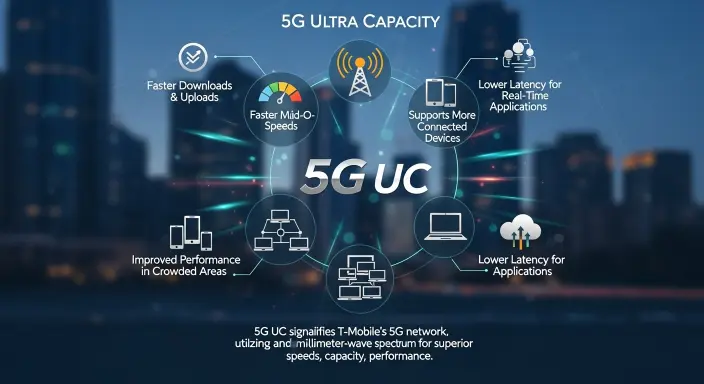
If you’ve noticed “5G UC” appearing on your phone but aren’t sure what it means, you’re not alone.
With 5G technology rapidly expanding, carriers have introduced terms like 5G+, mmWave, and UC, which can be confusing for everyday users.
But understanding 5G UC is important because it directly affects your mobile speed, network reliability, and overall experience.
So, what does 5G UC actually stand for?
UC means Ultra Capacity, a type of 5G network designed to deliver faster speeds, lower latency, and better coverage in crowded areas compared to standard 5G.
In simple terms, it’s what makes your video calls smoother, downloads quicker, and online gaming more responsive.
In this article, we’ll break down everything you need to know about 5G UC how it works, its benefits, supported devices, and how it differs from regular 5G so you can make the most of your 5G experience.
What Does 5G UC Stand For?
When you see 5G UC on your phone, the “UC” part can seem mysterious. In reality, it stands for Ultra Capacity, which is a marketing term carriers use to describe a specific type of 5G network.
Unlike standard 5G, which often relies on low-band frequencies for wider coverage but slower speeds, 5G UC primarily uses mid-band spectrum. This allows it to deliver a perfect balance between speed and coverage.
Think of it like this: low-band 5G is like a highway with many lanes but slower cars, while 5G UC is a highway with fewer cars but much faster speeds.
It’s designed to handle high data traffic efficiently, especially in urban areas, stadiums, and crowded events, where regular 5G networks might slow down.
Carriers often label their networks differently.
For example, Verizon may use terms like 5G UC or 5G+ depending on your location and signal type, while T-Mobile focuses on mid-band 5G as part of their Ultra Capacity network.
Knowing what UC means helps you understand why your phone shows different 5G icons in different locations.
In short, 5G UC is all about ultra-fast, reliable connectivity, bridging the gap between standard 5G and mmWave technology. Later sections will explain exactly how it works, its benefits, and how to check if your device supports it.
How 5G UC Works
5G UC, or Ultra Capacity, works by using a combination of mid-band spectrum frequencies that strike a balance between speed and coverage.
Unlike low-band 5G, which can travel long distances but offers moderate speeds, mid-band 5G UC delivers faster data transfer while still covering a significant area.
This makes it ideal for dense urban environments where many devices are connected at once.
Technically, 5G UC relies on 5G NR (New Radio) technology, which is the global standard for 5G wireless networks. It uses multiple antennas and advanced signal processing to improve both speed and reliability.
One of the key features is carrier aggregation, which combines multiple frequency bands to boost bandwidth and network capacity.
This is why 5G UC can provide faster downloads, smoother video streaming, and low-latency gaming experiences.
Another important aspect of 5G UC is network slicing, which allows carriers to allocate specific portions of the network for different uses, like video calls, gaming, or IoT devices.
This ensures that your connection remains stable even when many users are online simultaneously.
In short, 5G UC works by leveraging mid-band spectrum, advanced antenna technology, and network optimization techniques to provide a faster, more reliable experience than standard 5G.
Later, we’ll explore the practical benefits of 5G UC and how it compares to regular 5G.
Benefits of 5G UC
5G UC, or Ultra Capacity, isn’t just a fancy label it brings real benefits that improve your everyday mobile experience. One of the biggest advantages is faster speeds.
Mid-band spectrum allows 5G UC to deliver download and upload speeds several times higher than standard 5G, making it ideal for streaming high-definition videos, downloading large files, or playing online games without lag.
Another major benefit is lower latency, which means there’s less delay between sending and receiving data.
This is particularly important for activities like video conferencing, cloud gaming, and augmented reality applications. With 5G UC, your phone reacts faster, and online interactions feel smoother and more responsive.
5G UC also offers better network reliability, especially in crowded areas. Whether you’re at a concert, sports event, or busy city street, Ultra Capacity technology handles more simultaneous connections without slowing down.
This ensures a stable, uninterrupted experience even when thousands of users are online at the same time.
Finally, coverage in urban areas improves significantly. While mmWave 5G is extremely fast but limited to small areas, 5G UC covers larger zones while maintaining high speeds.
This balance between speed and coverage makes it perfect for daily use in cities and suburban areas.
In summary, 5G UC enhances your mobile experience by providing faster speeds, lower latency, higher reliability, and better coverage, making it the most practical 5G upgrade for most users.
5G UC vs Regular 5G
Understanding the difference between 5G UC and regular 5G can help you know what to expect from your mobile network. Regular 5G often relies on low-band spectrum, which provides wider coverage but slower speeds, similar to 4G LTE.
While it keeps you connected almost everywhere, it doesn’t always deliver the ultra-fast performance that modern apps, video streaming, and online gaming demand.
On the other hand, 5G UC (Ultra Capacity) primarily uses mid-band spectrum, which provides a sweet spot between speed and coverage.
This allows you to experience much faster download and upload speeds, lower latency, and better performance in crowded areas like stadiums, concerts, and city centers.
It’s essentially an upgraded version of 5G for users who need more performance.
Another distinction is how carriers label their networks. For instance, T-Mobile brands its mid-band 5G network as Ultra Capacity, while Verizon may use 5G UC or 5G+ to indicate faster 5G in certain regions.
Knowing these labels helps you understand why your phone might display different icons in different locations.
In short, regular 5G is about coverage, while 5G UC focuses on speed, capacity, and reliability. Choosing a device and carrier that support 5G UC ensures you get the best 5G experience where it matters most.
Devices That Support 5G UC
Not every smartphone can take advantage of 5G UC, so it’s important to know which devices are compatible.
Generally, newer flagship smartphones from major brands like Apple, Samsung, Google, and OnePlus support Ultra Capacity networks.
These devices are equipped with advanced 5G modems capable of connecting to mid-band spectrum, ensuring faster speeds and lower latency.
For example, on Apple devices, iPhone 12 and newer models support 5G UC in regions where carriers offer it. Samsung’s Galaxy S21, S22, S23 series, and higher-end Galaxy Note and Z series phones also support Ultra Capacity.
Google’s Pixel 6 and 7 series and recent OnePlus models are compatible as well. Checking your device’s specifications for 5G bands support can confirm whether it’s UC-ready.
Carrier compatibility is equally important. Major US carriers, including T-Mobile, Verizon, and AT&T, have rolled out 5G UC in select cities and regions.
T-Mobile brands it as Ultra Capacity, Verizon uses 5G UC, and AT&T includes it in its higher-speed 5G network tiers. Coverage maps are available on carrier websites to see if your area supports UC.
In short, to enjoy 5G UC, you need both a compatible smartphone and a carrier network offering Ultra Capacity in your location.
Having both ensures you experience the faster speeds, lower latency, and better reliability that UC promises.
Limitations of 5G UC
While 5G UC (Ultra Capacity) offers impressive speed, low latency, and better network performance, it isn’t without limitations.
Understanding these drawbacks helps set realistic expectations for your mobile experience.
One of the main limitations is availability. Unlike standard 5G, which uses low-band spectrum and covers large areas, 5G UC relies on mid-band spectrum.
This means it is mostly available in urban and suburban areas where carriers have deployed mid-band towers.
Rural or remote areas may not have access to UC networks yet, so users in those regions may see no difference from standard 5G.
Another limitation is device compatibility. Not all smartphones support 5G UC, and older or budget devices often lack the necessary 5G modems.
Even if your carrier offers UC, you won’t benefit unless your phone is capable of connecting to mid-band 5G networks.
Cost considerations can also be a factor. Some carriers include UC in higher-tier 5G plans, meaning you may need a premium data plan to access the full benefits.
This could result in higher monthly bills compared to standard 5G access.
Finally, network performance can vary depending on local congestion and infrastructure.
In extremely crowded areas, speeds may drop even on UC networks, though still generally faster than regular 5G.
In summary, while 5G UC improves speed and reliability, its limited availability, device requirements, cost, and occasional network congestion are factors to keep in mind before relying fully on Ultra Capacity.
How to Check if You Have 5G UC
If you’re curious whether your phone is connected to 5G UC, there are several simple ways to check.
First, look at the status bar on your smartphone. Most carriers display a small icon indicating the type of network you’re connected to.
For example, you may see “5G UC,” “5G+,” or “Ultra Capacity” depending on your carrier.
If your phone only shows 5G, it might be connected to a standard low-band 5G network rather than UC.
Another way to confirm is by using a speed test app, such as Ookla Speedtest or Fast.com.
If you notice download speeds consistently higher than typical 5G low-band speeds often exceeding 300–400 Mbps in ideal conditions you’re likely on a 5G UC network.
Keep in mind that speed can fluctuate depending on your location, network congestion, and device capabilities.
You can also check your carrier’s coverage map. Most major carriers like T-Mobile, Verizon, and AT&T provide maps showing where Ultra Capacity or 5G UC networks are available.
If your area is covered but your phone isn’t displaying UC, make sure your device supports mid-band 5G and that your software is updated.
Finally, some phones allow you to view network details in settings, showing the connected frequency bands.
Mid-band connection is usually a strong indicator of 5G UC. By checking these signals, you can ensure that you’re truly benefiting from the ultra-fast speeds and low latency that 5G UC provides.
The Future of 5G UC
The future of 5G UC (Ultra Capacity) looks promising, as carriers continue expanding mid-band 5G networks across more cities and regions.
With increasing demand for faster and more reliable mobile connections, Ultra Capacity is set to become the standard for high-performance 5G, especially in urban and suburban areas.
One major development is the expansion of mid-band spectrum. Carriers are investing in new towers and spectrum licenses to increase coverage and reduce network congestion.
This means more people will be able to enjoy the high speeds, low latency, and stable connections that 5G UC provides.
Another exciting aspect is the growth of applications that rely on faster networks. Technologies like augmented reality (AR), virtual reality (VR), cloud gaming, and IoT devices benefit greatly from UC networks.
With 5G UC, streaming AR experiences or participating in real-time multiplayer games becomes smoother and more responsive.
Additionally, network slicing and optimization will continue to improve. Carriers can allocate specific portions of the network for different purposes, ensuring critical applications like remote work or healthcare teleconferencing receive the bandwidth they need.
Finally, as more devices become UC-compatible, users will increasingly experience the advantages of ultra-fast 5G in everyday life.
From smart homes to self-driving cars and connected cities, 5G UC will play a key role in the next generation of mobile technology.
In short, the future of 5G UC promises faster speeds, wider availability, and transformative applications that will reshape how we use mobile networks.
FAQs:
1. What is the difference between 5G and 5G UC?
Regular 5G often uses low-band spectrum, offering wider coverage but moderate speeds, similar to 4G LTE. 5G UC, or Ultra Capacity, primarily uses mid-band spectrum, delivering faster speeds, lower latency, and better performance in crowded areas.
2. Does 5G UC work everywhere?
Not yet. 5G UC is mainly available in urban and suburban areas where carriers have deployed mid-band towers. Rural areas may only have access to standard 5G, so speeds can vary depending on location and coverage.
3. Can my phone get 5G UC?
Only 5G UC-compatible devices can connect to these networks. Newer smartphones from Apple, Samsung, Google, and OnePlus usually support Ultra Capacity. Older or budget phones may not be compatible, even if your carrier offers UC.
4. How can I check if I have 5G UC?
Look at the status bar for the “5G UC” or “Ultra Capacity” icon. You can also use speed test apps to measure faster mid-band speeds, or check your carrier’s coverage map to confirm UC availability.
5. Is 5G UC faster than 5G+ or mmWave?
5G UC generally provides faster and more reliable performance than standard 5G, but mmWave can still offer higher peak speeds in short-range areas. UC balances speed, coverage, and reliability, making it more practical for daily use.
These FAQs address the most common questions about 5G UC, helping readers understand the technology, its availability, and how to use it effectively.
Conclusion:
In summary, 5G UC (Ultra Capacity) represents the next step in the evolution of 5G networks, offering a perfect balance between speed, reliability, and coverage.
Unlike standard 5G, which mainly relies on low-band frequencies, 5G UC uses mid-band spectrum to provide faster downloads, lower latency, and better performance in crowded areas.
This makes it ideal for streaming high-definition content, online gaming, video conferencing, and other data-intensive applications.
To take full advantage of 5G UC, you need both a compatible device and access to a carrier network that supports Ultra Capacity.
Major smartphones from Apple, Samsung, Google, and OnePlus are already UC-ready, and leading carriers like T-Mobile, Verizon, and AT&T continue to expand their 5G UC coverage.
Checking your device’s status bar, using speed test apps, or consulting your carrier’s coverage map can help you confirm if you’re connected to UC.
While 5G UC has some limitations such as availability in rural areas, device requirements, and potential cost factors its benefits make it a significant upgrade over standard 5G.
As carriers continue to expand UC networks and more devices become compatible, 5G UC will play a central role in the future of mobile connectivity, enabling faster, smoother, and more reliable experiences for users worldwide.
Ultimately, understanding 5G UC helps you make informed decisions about upgrading devices or choosing a network plan, ensuring you get the best performance from the evolving world of 5G technology.

I am Toni Morrison, the creative voice behind jokestide.com where humor meets trending jokes and puns.
I craft fresh, fun, and share-worthy content designed to make people smile instantly.
If you love viral laughs and clever wordplay, you’ve landed on the right joke tide.