Have you ever overheard someone say, Wham Bam Thank You Ma’am, and thought, “Wait what does that even mean?
If so, you’re not alone. This quirky phrase is one of those colorful pieces of English slang that can sound funny, confusing, or even a little cheeky depending on who’s saying it.
At its core, it describes something done quickly and efficiently, often with a playful or mischievous undertoneand yes, sometimes it carries a sexual connotation.
But it’s not always about romance; it’s used humorously in casual conversations, memes, and even pop culture references to describe anything that happens in a flash.
In this article, we’ll dive deep into the meaning, origin, modern usage, and cultural context of “Wham Bam Thank You Ma’am,” plus explore similar phrases and fun trivia.
By the end, you’ll not only understand it but also know exactly whenand when notto use it.
Literal Meaning of Wham Bam Thank You Ma’am
To truly understand “Wham Bam Thank You Ma’am,” it helps to break it down word by word. “Wham” and “Bam” are onomatopoeic wordsbasically, they imitate sounds of impact or sudden action.
Together, they emphasize speed, force, and abruptness, like something happening so quickly it barely registers.
Next, “Thank You” signals the conclusion or acknowledgment of the actionit’s like saying, “All done, and moving on.
Finally, “Ma’am” is traditionally a polite form of address, but in this phrase, it adds a slightly cheeky or sarcastic tone.
When combined, the phrase generally describes something done swiftly and efficiently, often without lingering.
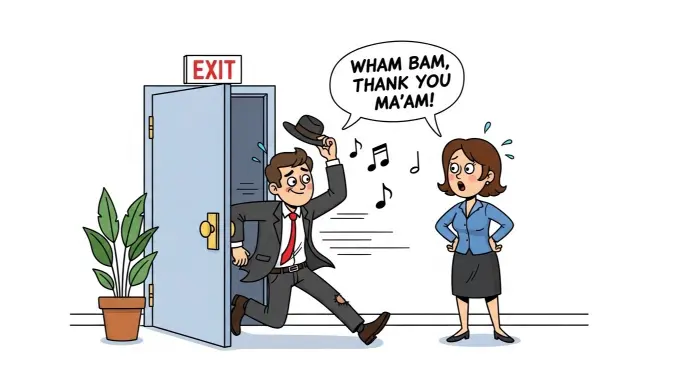
In modern slang, it’s frequently used to describe quick, casual sexual encounters, though it can also be applied humorously to non-sexual scenarioslike finishing a task rapidly or leaving a party abruptly.
For example, someone might joke, “I finished my homework, wham bam thank you ma’am!” to exaggerate how fast they completed it.
It’s important to note that the context determines the tone. Among friends, it can be playful and funny.
In professional or formal settings, however, it could be considered inappropriate or crass.
Essentially, the phrase is about speed, brevity, and a touch of audacity, making it memorable, humorous, and slightly edgyall reasons why it has persisted in pop culture and everyday slang.
Origin & History of Wham Bam Thank You Ma’am
The phrase “Wham Bam Thank You Ma’am” has a colorful history rooted in English slang and pop culture, though its exact origin is a bit tricky to pinpoint.
The earliest uses of the words “wham” and “bam” date back to the early 20th century, primarily as comic or onomatopoeic expressions in newspapers, comic strips, and cartoons to indicate sudden action or impact.
Adding “thank you ma’am” later turned it into a witty, rhyming phrase that carried a punchy, memorable rhythmperfect for slang.
By the mid-20th century, the phrase began appearing in songs, movies, and theatrical works, often implying a quick sexual encounter or a rapid sequence of events.
One of the most notable popularizations was in music from the 1970s, where playful, cheeky lyrics used the phrase to add humor and suggestiveness.
Over time, it became part of casual spoken English, often used humorously or sarcastically in everyday conversation.
Its evolution is interesting: what started as simple sound effects evolved into a metaphorical expression with social and cultural nuance.
Today, it’s recognized both for its literal meaningsomething done quicklyand its figurative or sexual undertone.
It’s also become a meme-worthy phrase, appearing on social media, in humorous posts, and even in modern music references, keeping it alive in contemporary slang.
In short, “Wham Bam Thank You Ma’am” has traveled from comic strips to pop culture, becoming a versatile, cheeky expression that blends speed, humor, and a touch of audacity.
Modern Usage of Wham Bam Thank You Ma’am
Today, “Wham Bam Thank You Ma’am” has evolved into a phrase widely recognized in casual speech, pop culture, and internet humor.
While its origins hinted at sudden action or sexual encounters, modern usage has broadened.
People use it to describe anything that happens quickly, efficiently, or abruptly, often with a humorous twist.
For example, finishing a project, leaving a party, or even eating a meal unusually fast could be jokingly described with this phrase.
On social media platforms like TikTok, Twitter, and Instagram, the phrase is often used in memes, captions, or short videos, emphasizing speed or a “blink-and-you-miss-it” moment.
Its playful rhyme and rhythmic flow make it catchy, memorable, and perfect for comedic timing. It’s especially common among younger audiences who enjoy cheeky or slightly irreverent humor.
However, context is crucial. In casual conversations with friends, the phrase can be lighthearted and funny.
In professional, formal, or unfamiliar settings, it may come across as inappropriate due to its sexual connotations. Understanding the audience is key to using it effectively.
Interestingly, the phrase has also inspired creative adaptations, such as merchandise, song lyrics, and viral content, further cementing its place in modern slang.
It demonstrates how language can evolve from simple comic expressions into versatile cultural shorthand, reflecting humor, speed, and audacity all while keeping its playful edge intact.
Cultural & Social Implications of Wham Bam Thank You Ma’am
While “Wham Bam Thank You Ma’am” may seem lighthearted and funny, it carries interesting cultural and social nuances.
The phrase is often associated with cheeky humor and quick, efficient action, but depending on the audience, it can also carry sexual undertones.
For younger generations or casual social settings, it is usually understood as a playful expression, a way to joke about speed, efficiency, or humorous situations.
In memes, captions, and social media posts, it often conveys a sense of witty exaggeration, highlighting just how fast or abrupt something happened.
However, among older audiences or in professional or formal contexts, the phrase can be misinterpreted as inappropriate or crass.
Its sexual innuendo makes it context-sensitive, meaning that timing, audience, and tone are crucial when using it.
Additionally, cultural differences influence perception: in some English-speaking countries like the UK, the phrase may feel more humorous and less sexual, while in the US, the cheeky, suggestive meaning tends to dominate.
The phrase also reflects broader trends in language, showing how slang evolves to blend humor, cultural reference, and rhythm.
Its persistence in pop culture, music, and online content illustrates the human love for playful, catchy expressions that can convey multiple layers of meaning in just a few words.
Ultimately, “Wham Bam Thank You Ma’am” is more than just a phraseit’s a cultural artifact that demonstrates how humor, social norms, and context shape the way language is used and interpreted today.
Similar Phrases & Expressions
If you’ve ever heard “Wham Bam Thank You Ma’am,” you might notice that English is full of playful slang phrases that convey quick, efficient, or cheeky actions.
These expressions often carry humor, exaggeration, or subtle innuendo, making them memorable in conversation.
Understanding similar phrases can help you see where “Wham Bam Thank You Ma’am” fits in the landscape of casual language.
One common alternative is “in and out,” which similarly describes a fast action, sometimes with a sexual connotation, but also applicable to everyday tasks like errands or chores.
Each of these phrases shares the theme of brevity and efficiency, but their tone and acceptability vary depending on context.
Even non-sexual expressions like “blink and you’ll miss it” or “before you know it” capture the essence of speed or suddenness.
What sets “Wham Bam Thank You Ma’am” apart is its rhythmic, playful rhyme and slightly audacious humor, making it more memorable and culturally recognizable.
By comparing these phrases, it becomes clear that English speakers enjoy using catchy, humorous expressions to describe quick actions.
Wham Bam Thank You Ma’am” thrives because it blends speed, wit, and audacity into a single, unforgettable linear quality many similar expressions aim for but few fully achieve.
Fun Facts & Trivia About Wham Bam Thank You Ma’am
One of the reasons “Wham Bam Thank You Ma’am” has stayed memorable is its presence in pop culture and humor, giving it life beyond casual conversation.
The phrase has appeared in songs, movies, and television shows, often used to add a cheeky, fast-paced punch to dialogue or lyrics.
For instance, several songs from the 1970s and 1980s incorporated the phrase humorously, using its rhythm to emphasize quick encounters or actions.
On social media, the phrase has become a meme favorite, particularly for content that highlights things happening suddenly or unexpectedly.
TikTok and Instagram reels often use it as a caption to exaggerate the speed of a funny or absurd moment, from finishing homework in seconds to devouring a snack before anyone notices.
Its catchy rhyme and comedic tone make it perfect for viral content, which keeps it alive in modern slang.
Some take it literally, imagining a loud “wham” or “bam” happening in quick succession, while others miss the subtle humor entirely.
This playful ambiguity adds to its charm.
Finally, the phrase’s longevity shows the power of rhyming, rhythmic slang.
Just like comic strips or catchy jingles, “Wham Bam Thank You Ma’am” is easy to remember and repeat, ensuring it continues to be a humorous and slightly audacious expression in English culture today.
FAQs:
1. What does “Wham Bam Thank You Ma’am” mean?
The phrase generally describes something done quickly and efficiently, often with a playful or cheeky undertone. In modern slang, it can also refer to a brief sexual encounter, though it’s frequently used humorously in non-sexual contexts too.
2. Where did the phrase originate?
“Wham Bam Thank You Ma’am” originated from early comic strips and onomatopoeic expressions in English. Its rhyming, rhythmic structure made it popular in music, movies, and theater by the mid-20th century.
3. Is it appropriate to use in formal settings?
No. Because of its sexual undertones and cheeky humor, it is best reserved for casual conversations among friends or in humorous content. Using it in professional or formal settings can be considered inappropriate.
4. How is it used in pop culture today?
The phrase appears in songs, memes, social media posts, and videos to describe quick or sudden actions. Its catchy rhyme makes it ideal for humorous captions and viral content.
5. Are there similar phrases?
Yes. Phrases like “in and out,” “one and done,” or “quickie” convey similar ideas of brevity or speed. What makes “Wham Bam Thank You Ma’am” unique is its playful, audacious, and memorable rhythm.
6. Can it be used humorously in everyday life?
Absolutely. It’s often used to exaggerate how fast or abrupt something happens like finishing chores, leaving a party, or completing tasks quickly, adding a fun and cheeky twist to ordinary situations.
Conclusion
Wham Bam Thank You Ma’am” is more than just a quirky string of wordsit’s a playful, memorable phrase that captures speed, efficiency, and a touch of cheeky humor.
From its early use in comic strips and pop culture to its modern life on social media and memes, the phrase has proven to be versatile, entertaining, and culturally resonant.
Its rhyming structure and audacious tone make it stand out among English slang, allowing it to convey quick action or humorous encounters in a way that few phrases can.
While often used jokingly, it’s important to recognize the context and audience, as its sexual undertones may not always be appropriate.
At the same time, its humor and brevity are what keep it alive in casual conversations, viral content, and even music references.
Next time you hear or use the phrase, you’ll understand the history, meaning, and cultural layers behind it turning a fun saying into a well-understood piece of English slang.

I am Harper Lee, the voice behind Jokestide.com, where humor meets creativity.
I am here to serve fresh, trending jokes and puns that make every scroll worth it.
I am turning everyday smiles into share-worthy laughs welcome to the fun side of the web