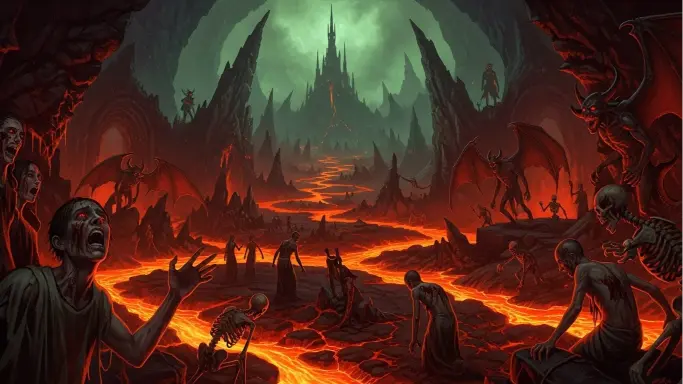
Imagine stepping into a place where every sound is a scream, every breath feels like fire, and every corner hides unimaginable torment.
Hell has fascinated humanity for centuries, appearing in religious texts, literature, art, and even modern pop culture.
But what does hell actually look like? Is it a literal landscape of flames and darkness, or a symbolic reflection of human fears and moral consequences?
From Dante’s fiery Inferno to the frozen pits of Norse mythology, the visions of hell are as varied as the cultures that imagined them.
Yet, despite the differences, they share a common purpose: to warn, to teach, and to confront us with the extremes of suffering and isolation.
In this post, we’ll explore hell through multiple lenses religious, literary, artistic, and psychological, unpacking its vivid imagery and uncovering what it truly symbolizes in the human experience.
Hell in Religious Texts
Across the world’s religions, hell has been imagined in vivid, often terrifying ways, serving as a place of punishment for wrongdoing and a reflection of moral order.
In Christianity, hell is famously depicted in Dante Alighieri’s Inferno, where sinners descend through nine circles, each designed for a specific type of sin.
Fire, darkness, and endless torment dominate these depictions, symbolizing the consequences of moral failings.
While Catholicism emphasizes punishment and redemption, some Protestant traditions view hell more as eternal separation from God rather than physical torment.
In Islam, hell known as Jahannam is described in the Quran as a place of blazing fire, boiling water, and chains, with varying levels of punishment depending on one’s deeds.
The vivid imagery is meant to instill moral awareness and encourage righteous living.
Meanwhile, Hinduism and Buddhism describe Naraka, realms of temporary punishment for those whose karma has led them astray.
Unlike eternal damnation, souls suffer in these realms until their karmic debts are resolved, reflecting a more cyclical view of morality and consequence.
Even in ancient mythologies, like the Norse Hel or Greek Hades, hell-like realms exist as shadowy domains where the dead face consequences or isolation.
Across cultures, hell serves a dual purpose: a warning against immoral behavior and a symbolic space where the deepest human fears are projected.
Hell in Literature and Art
Hell has long inspired writers and artists to bring human fears to life, creating images that linger in our imagination.
In classic literature, Dante’s Inferno remains the most famous depiction, with its nine circles of hell, each punishing specific sins.
The vivid descriptions of fire, ice, and grotesque creatures symbolize the consequences of immoral choices.
Similarly, John Milton’s Paradise Lost portrays hell as a desolate, fiery wasteland, emphasizing both physical torment and spiritual despair.
These works do more than entertain they shape how generations envision suffering and morality.
In visual art, painters like Hieronymus Bosch and Gustave Doré created hellscapes filled with twisted, nightmarish figures, chaotic landscapes, and symbolic imagery.
Fire, darkness, and grotesque forms dominate these scenes, representing sin, fear, and eternal punishment.
Such artworks translate abstract concepts of guilt and retribution into tangible, often horrifying, visuals.
Modern culture continues this tradition. Films like Hellraiser or Constantine and video games such as Dante’s Inferno use advanced visual effects to immerse audiences in hellish environments.
These depictions blend imagination with symbolism, portraying hell not just as a physical place but also as a psychological and emotional state.
Through literature and art, hell becomes more than religious doctrine; it becomes a canvas for exploring human fears, morality, and the consequences of our choices.
Each depiction, from medieval painting to modern cinema, reveals both cultural beliefs and universal anxieties about suffering, justice, and the unknown.
Psychological and Symbolic Interpretations
Beyond religious texts and artistic depictions, hell can also be understood as a psychological and symbolic concept.
In this sense, hell represents the inner landscapes of fear, guilt, and suffering that humans experience.
Many psychologists argue that “personal hells” manifest as anxiety, depression, addiction, or unresolved trauma conditions that feel as inescapable as the fiery pits described in ancient scriptures.
Just as Dante’s circles of hell punish specific sins, these inner hells often reflect the consequences of choices, regrets, or moral conflicts.
Symbolically, hell serves as a mirror to human behavior and morality. Writers and philosophers frequently use it to explore justice, isolation, and existential dread.
For instance, Jean-Paul Sartre famously suggested in No Exit that “hell is other people,” highlighting how human relationships can generate profound psychological suffering.
In this way, hell is less a physical place and more a state of consciousness an embodiment of the consequences of ethical failings or unchecked fears.
Hell also functions as a cultural tool, warning societies against immoral actions and reinforcing ethical norms.
By projecting fears into a tangible realm, humans can confront moral dilemmas and imagine the results of transgression.
This symbolic approach bridges religion, literature, and psychology, offering a multi-layered understanding of suffering.
Whether experienced externally as punishment or internally as mental anguish, hell persists as a powerful metaphor for the darkest dimensions of human existence.
Common Themes Across All Depictions
Despite differences in culture, religion, and media, depictions of hell share several common themes that reveal universal human concerns.
One of the most persistent motifs is suffering whether physical, emotional, or spiritual.
From the fiery pits of Dante’s Inferno to the frozen torment of Norse Hel, hell is consistently portrayed as a place where pain is inescapable and relentless.
This suffering often reflects the consequences of moral failings, sins, or wrong choices, reinforcing the idea that actions have repercussions.
Isolation is another recurring theme. In many interpretations, hell is a realm of separation from loved ones, from divine grace, or even from hope itself.
This alienation magnifies the torment, creating an environment of despair and loneliness that resonates with human fears of abandonment.
Chaos and extreme environments also dominate hellish imagery. Whether depicted through raging fire, unending darkness, or surreal landscapes, these extremes symbolize the disruption of order, harmony, and safety.
They visually communicate that hell is a realm fundamentally different from the comfort and predictability of the human world.
Finally, moral and psychological lessons are embedded in every depiction. Hell is rarely presented as mere punishment; it is a cautionary mirror reflecting human fears, desires, and ethical boundaries.
Across religions, literature, and art, hell serves both as a warning and as a canvas for exploring the deepest aspects of human existence: fear, guilt, and the consequences of our choices.
Why Humans Imagine Hell
Humans have long imagined hell, and it serves multiple purposes beyond religious doctrine.
At its core, hell is a projection of fear, a symbolic way to confront the unknown, mortality, and the consequences of human actions.
Evolutionary psychologists suggest that envisioning extreme punishment and suffering helped early societies enforce moral behavior and social cohesion.
By imagining the horrors of hell, people were encouraged to act ethically, avoid wrongdoing, and maintain harmony within their communities.
Culturally, hell functions as a moral compass. Across religions and mythologies, stories of punishment and torment emphasize accountability, teaching lessons about justice, integrity, and the consequences of ethical lapses.
These narratives help societies transmit values from one generation to the next, using fear and imagination as powerful educational tools.
On a personal level, hell often represents the inner struggles of the mind. Guilt, regret, anxiety, and trauma are experienced as personal “hells,” reflecting the same themes of isolation, suffering, and consequence found in religious or literary depictions.
By conceptualizing these feelings as a hellish landscape, humans can externalize and make sense of their deepest fears, sometimes even using them as motivation for change and personal growth.
Finally, hell in art, literature, and media allows humans to explore moral and existential questions safely.
Through these imaginative landscapes, we confront our fears, reflect on morality, and grapple with questions of life, death, and justice all while engaging with stories that are as visually and emotionally compelling as they are instructive.
Modern Reflections on Hell
In today’s world, hell continues to captivate imagination, but its depictions have evolved beyond religious or classical frameworks.
In pop culture, films, TV shows, and video games often portray hell as a visually striking, immersive environment ranging from fiery infernos in Hellraiser to surreal, dystopian realms in video games like Dante’s Inferno.
These modern representations emphasize both spectacle and psychological tension, showing hell as a place where fear, chaos, and moral reckoning intersect.
Modern literature also reimagines hell in symbolic and philosophical ways. Writers explore personal hells, representing emotional turmoil, addiction, or existential despair.
In this sense, hell becomes less a physical place and more a reflection of the human psyche, highlighting the internal struggles that feel as inescapable as traditional depictions of eternal torment.
Pop culture and psychology converge in ways that make hell relevant for contemporary audiences.
Hell is no longer only a religious warning; it’s a tool for exploring morality, consequence, and the limits of human endurance.
Artists and writers use hellish imagery to provoke reflection, encourage ethical consideration, and evoke empathy for human suffering.
Even in everyday life, the concept of hell resonates. People describe “going through hell” when facing trauma, loss, or extreme challenges.
This modern understanding bridges the ancient with the contemporary, showing that hell whether literal, symbolic, or psychological remains a powerful lens through which humans examine fear, morality, and the extremes of experience.
FAQs
1. What does hell look like according to religion?
Hell varies across religions. In Christianity, it is often depicted as a fiery realm of eternal punishment. Islam describes Jahannam with fire, boiling water, and chains, while Hinduism and Buddhism describe Naraka, temporary realms of karmic punishment. Despite differences, all emphasize suffering, isolation, and moral consequences.
2. Is hell real or symbolic?
Many scholars and psychologists see hell as both literal and symbolic. Religions often portray it literally, but literary, artistic, and psychological interpretations suggest it represents moral consequences, inner guilt, and human fears.
3. What are the common themes in depictions of hell?
Across cultures, hell consistently emphasizes suffering, isolation, chaos, and moral retribution. Fire, darkness, extreme landscapes, and grotesque imagery are common elements, reflecting the universality of fear and punishment.
4. How is hell represented in literature and art?
From Dante’s Inferno to Hieronymus Bosch’s paintings, hell is depicted with vivid, often terrifying imagery. Modern literature and media continue this tradition, creating symbolic, emotional, and visual portrayals of human suffering and moral lessons.
5. Can hell exist in the human mind?
Yes. Psychologists describe “personal hells” as states of guilt, anxiety, trauma, or depression. These internal hells mirror the themes of suffering, isolation, and fear found in cultural depictions, showing that hell can be both external and internal.
6. Why do humans imagine hell?
Hell serves as a moral warning, cultural lesson, and tool for exploring fears. It helps humans reflect on ethics, consequences, and the extremes of the human condition, both in society and within themselves.
Conclusion
Hell, as a concept, has fascinated humanity for centuries, appearing in religion, literature, art, and even modern media.
Across cultures, it has been depicted as fiery pits, frozen wastelands, chaotic landscapes, or symbolic realms of moral consequence.
Despite these differences, common threads run through every portrayal: suffering, isolation, chaos, and the consequences of human actions.
If imagined as a place of eternal punishment or a psychological state of despair, hell reflects humanity’s deepest fears and moral considerations.
Religious texts like the Bible, Quran, and Hindu scriptures provide vivid imagery of hell, reinforcing moral lessons and warning of ethical transgressions.
Literary works and visual arts expand on these depictions, transforming abstract ideas of suffering into tangible, often haunting experiences.
Meanwhile, psychological and symbolic interpretations reveal that hell exists not just externally but within us, in our guilt, regrets, and personal struggles.
Even modern depictions in films, games, and literature continue this tradition, demonstrating that hell remains relevant, adaptable, and deeply tied to human experience.
Ultimately, imagining hell serves multiple purposes: it warns, it teaches, and it mirrors the human condition.
It reminds us of the consequences of our choices, the extremes of suffering, and the inner landscapes of fear and guilt.
If literal or symbolic, hell is more than a place it is a reflection of our values, our anxieties, and our enduring fascination with the unknown.
By exploring its many forms, we gain insight into both culture and ourselves.

I am Zadie Smith, the mind behind witty words and viral laughs on Jokestide.com.
I am here to turn everyday moments into clever jokes, puns, and share-worthy humor.
I am all about fresh, trending fun that makes you smile, scroll, and come back for more.