If you’ve been following the news or social media lately, chances are you’ve come across the term “Antifa” and wondered what it really stands for.
At first glance, it might seem like a mysterious organization, but the truth is both simpler and more complex: Antifa is short for “anti-fascist,” and it represents a loosely connected movement opposing fascism, racism, and far-right extremism.
Unlike a traditional organization, it doesn’t have a central leadership or formal membership; its actions are carried out by local groups or individuals who share the same core beliefs.
Despite its presence in headlines, there are many misconceptions surrounding Antifa, from allegations of violence to claims that it is a coordinated national entity.
In this article, we’ll break down the meaning, history, activities, and controversies of Antifa, helping you understand the movement from its historical roots to its role in today’s political landscape.
Definition of Antifa
Antifa, short for “anti-fascist,” is not a formal organization but a broad movement united by opposition to fascism, far-right extremism, and racism.
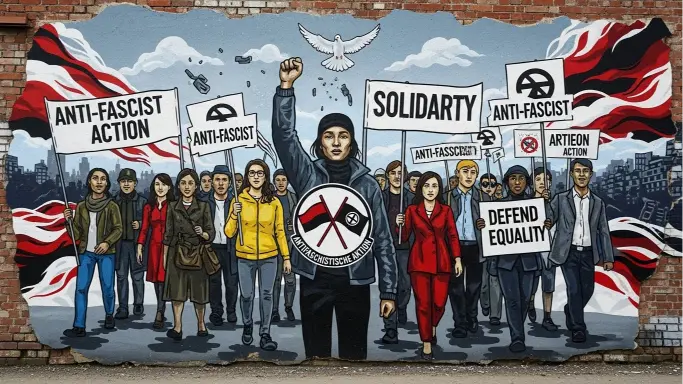
The term itself originates from the German word “Antifaschistische Aktion,” which referred to anti-fascist groups that emerged in Europe during the 1920s and 1930s to resist the rise of authoritarian regimes.
Today, Antifa represents a decentralized network of activists and local groups rather than a hierarchical organization with official leaders or membership.
At its core, the movement is guided by the principle of resisting ideologies and actions that promote oppression, hate, or authoritarian control.
Members or supporters often engage in protests, counter-protests, and community organizing to challenge hate groups and far-right activities.
Importantly, Antifa is ideologically diverse, encompassing a range of left-leaning political beliefs, united only by their opposition to fascism.
Because of its decentralized nature, Antifa’s activities vary widely depending on the local group or context.
Some groups focus on education, raising awareness about far-right threats, and providing community support, while others participate in public demonstrations and counter-protests.
This loose structure often leads to misconceptions, with some perceiving Antifa as a single organization or labeling it as violent, which is not accurate for the movement as a whole.
Understanding this basic definition sets the stage for exploring Antifa’s historical roots and modern presence, which we will cover in the next section.
Historical Origins of Antifa
The roots of Antifa can be traced back to Europe in the early 20th century, a period marked by political instability and the rise of fascist regimes.
In the 1920s and 1930s, anti-fascist groups began forming in Germany and Italy to oppose the growing power of leaders like Adolf Hitler and Benito Mussolini.
One of the most notable early examples was the Antifaschistische Aktion in Germany, which organized protests, rallies, and public campaigns against the Nazi Party and other far-right groups.
These movements were often composed of left-wing activists, including socialists, communists, and labor union members, united by a commitment to resist authoritarianism and protect vulnerable communities.
After World War II, the anti-fascist movement continued in Europe, particularly in Germany, where local groups worked to prevent the resurgence of neo-Nazi organizations.
The ideology of resisting fascism became a lasting part of political activism in various countries.
In the United States, Antifa began gaining attention in the late 20th century, largely as a response to white supremacist rallies, neo-Nazi groups, and far-right extremism. U.S.-based anti-fascist activists often borrowed inspiration from European models but adapted strategies to local political and social contexts, focusing on counter-protests, community education, and monitoring hate groups.
Understanding these historical origins is crucial because it highlights that Antifa is not a sudden or modern invention, but rather a continuation of decades-long anti-fascist activism that responds to threats of authoritarianism and extremism wherever they appear.
Modern Antifa
Today, Antifa is primarily recognized as a decentralized anti-fascist movement rather than a formal organization.
In the United States and other countries, it consists of local groups, activist networks, and individual participants who share a commitment to opposing fascism, racism, and far-right extremism.
Because there is no central leadership, modern Antifa operates through a variety of approaches, tailored to local needs and political climates.
The core goals of modern Antifa include raising awareness of extremist threats, countering hate groups, and defending marginalized communities from far-right intimidation.
Activities vary widely: some groups focus on community organizing, education, and outreach, while others engage in protests and counter-protests at rallies organized by white supremacists or far-right organizations.
Many supporters also monitor extremist activity online and work to expose harmful ideologies.
Modern Antifa emphasizes a diverse range of tactics, from peaceful demonstrations to more confrontational forms of activism.
This diversity reflects the movement’s decentralized nature, allowing individual groups to decide how best to address threats in their local communities.
Despite its intentions, modern Antifa often appears in the media during confrontations with far-right groups, which can create the impression of widespread violence or coordination.
In reality, actions are localized, spontaneous, and often defensive rather than part of an organized national agenda.
By understanding how Antifa operates today, we can see it as a continuation of historical anti-fascist efforts, adapted to modern challenges, digital platforms, and current political climates.
Misconceptions & Controversies
Antifa is often misunderstood, and misconceptions about the movement are widespread in both media and public discourse.
One common myth is that Antifa is a single, centralized organization with a national hierarchy.
In reality, the movement is decentralized, composed of loosely connected local groups and individual activists who share anti-fascist principles but operate independently.
This structure makes it impossible to define a unified leadership or formal membership.
Another misconception is that Antifa is inherently violent. While some confrontations at protests have led to clashes, most Antifa activities are non-violent, focusing on education, awareness campaigns, and peaceful counter-protests.
Media coverage often highlights the few incidents involving physical altercations, which can distort public perception and create fear or misinformation.
Political debates have also contributed to controversy, with some politicians labeling Antifa as a terrorist organization.
Legal experts and law enforcement agencies, however, clarify that Antifa is not banned or classified as such; it remains a movement rather than an official entity, meaning its legal status differs from formal extremist groups.
Finally, social media has amplified misunderstandings, spreading images, videos, and claims without context.
This often conflates unrelated protests or actions with Antifa, reinforcing false narratives.
Clarifying these misconceptions is essential for a fair understanding of Antifa.
Recognizing it as a loosely organized, anti-fascist movement helps distinguish between sensationalized portrayals and the movement’s actual purpose: opposing authoritarianism, racism, and far-right extremism in communities worldwide.
Legal and Political Perspective
From a legal standpoint, Antifa is not classified as a formal organization or banned group in the United States.
Because it is a decentralized movement, there is no official structure to regulate or prosecute as a single entity.
This distinction is important: while individual members can be arrested for illegal actions, such as property damage or assault during protests, these incidents do not define the movement as a whole.
Law enforcement treats Antifa similarly to any other activist group, focusing on specific unlawful behavior rather than affiliation.
Politically, Antifa is often a topic of debate. Some politicians label it as dangerous or associate it with violence, while others emphasize its role in opposing far-right extremism and protecting vulnerable communities.
These political perspectives can influence public opinion, sometimes creating a polarized view of the movement that doesn’t reflect its historical anti-fascist roots or decentralized nature.
Internationally, Antifa-inspired movements exist in countries like Germany, the United Kingdom, and France.
In Europe, anti-fascist activism has long been part of civil society, often operating legally under the protection of free assembly and speech laws.
Local governments monitor protests for safety but generally recognize anti-fascist activism as a legitimate political expression.
Understanding the legal and political context of Antifa helps separate myths from reality.
It highlights that while individual actions may be scrutinized or criticized, the movement itself remains a legal, ideologically driven network dedicated to resisting fascism and far-right extremism worldwide.
Antifa in the Media
Antifa frequently appears in news coverage, social media, and political commentary, making it one of the most talked-about activist movements in recent years.
However, media portrayals often vary widely depending on the source, which can create confusion and misconceptions about the movement.
Some outlets emphasize confrontations at protests, framing Antifa as aggressive or violent, while others highlight the movement’s efforts to combat racism, fascism, and far-right extremism.
Social media has further amplified these perceptions. Videos, images, and news clips are shared rapidly, sometimes without context, leading to the misidentification of individuals or events as “Antifa actions.”
Memes, opinion pieces, and political commentary often exaggerate or oversimplify the movement, reinforcing myths about its size, coordination, or intentions.
Despite these challenges, Antifa supporters and historians argue that the movement’s portrayal in the media often overlooks its educational and community-focused efforts.
Activities such as workshops on anti-fascism, community defense programs, and online monitoring of extremist groups rarely receive the same attention as street protests, yet they are crucial to understanding the movement’s purpose.
For readers, it is important to differentiate fact from opinion. Recognizing the movement’s decentralized nature and historical context helps separate sensationalized headlines from reality.
By analyzing both mainstream media and alternative sources, it becomes clear that Antifa’s role is more nuanced than media narratives often suggest rooted in anti-fascist principles rather than a single, organized agenda.
FAQs
1. Is Antifa a violent group?
While some protests involving Antifa have led to confrontations, the movement itself is not inherently violent. Most activities focus on education, awareness, and peaceful counter-protests against far-right groups. Violence, when it occurs, is usually local and spontaneous rather than organized.
2. Who can join Antifa?
Antifa has no formal membership or central authority. Anyone who shares the movement’s anti-fascist principles can participate in local actions or support initiatives. Participation ranges from attending protests to volunteering in educational campaigns or online activism.
3. What are the main goals of Antifa?
The core goal of Antifa is to oppose fascism, racism, and far-right extremism. Activities may include countering hate groups, protecting marginalized communities, raising awareness of extremist threats, and promoting anti-authoritarian values.
4. How does Antifa organize protests?
Because it is decentralized, organization occurs locally, with small groups or individuals planning events based on community needs. Communication often happens through private online networks, social media, and word-of-mouth.
5. Is Antifa legal?
Yes. Antifa is considered a movement rather than a formal organization, so its existence is legal in the U.S. and most democratic countries. Law enforcement only intervenes if specific illegal actions occur.
6. Where did Antifa originate?
Antifa has its roots in Europe during the 1920s and 1930s, particularly in Germany and Italy, as anti-fascist activists resisted authoritarian regimes. Modern U.S. Antifa draws inspiration from these historical movements.
Conclusion
Antifa, short for anti-fascist, is a movement that has evolved over decades, from its historical roots in 1920s and 1930s Europe to its modern presence in the United States and beyond.
Unlike a traditional organization, Antifa is decentralized and loosely connected, meaning it has no official leaders, formal membership, or centralized command.
Its core mission remains consistent: opposing fascism, racism, and far-right extremism, whether through protests, counter-protests, educational efforts, or community activism.
Throughout its history, Antifa has been misunderstood and misrepresented in both media and political discourse.
Myths about violence, organization, or national coordination have often overshadowed the movement’s actual goals. In reality, most Antifa activities are focused on raising awareness, promoting anti-authoritarian values, and protecting vulnerable communities.
The decentralized nature allows local groups to respond flexibly to threats in their communities, making the movement adaptive but also prone to misconceptions.
Understanding Antifa requires separating fact from fiction.
By learning about its historical origins, ideological foundations, modern activities, and legal standing, readers can appreciate it as a legitimate anti-fascist movement rather than a sensationalized or monolithic entity.
If you agree or disagree with its methods, Antifa plays a significant role in highlighting the ongoing resistance to authoritarianism and hate-driven ideologies.
In the end, exploring what Antifa stands for is not just about understanding a movement it’s about recognizing the broader struggle against fascism, extremism, and intolerance that continues to shape societies worldwide.

I am Toni Morrison, the creative voice behind jokestide.com where humor meets trending jokes and puns.
I craft fresh, fun, and share-worthy content designed to make people smile instantly.
If you love viral laughs and clever wordplay, you’ve landed on the right joke tide.